As an Amazon Associate this site earns from qualifying purchases.
Quick Picks
| Product | Best suited to | Key published spec | Link |
|---|---|---|---|
| HTVRONT Auto Heat Press Machine for T Shirts - 15x15 Smart T Shirt Press Machine with Auto Release | Flat apparel work in both sublimation and HTV | Manufacturer states it auto-adjusts to project thickness up to 1 inch and auto-releases when the timer ends | Check Price on Amazon |
| HTVRONT Auto Tumbler Heat Press Machine - Sublimation Tumblers, Glasses (B0CG166C88) | Sublimating tumblers by diameter and metric volume | Listing states it fits 2.9 to 3.2 inch diameters, 280ml-850ml | Check Price on Amazon |
| HTVRONT Auto Tumbler Heat Press Machine - Sublimation Tumblers, Glasses (B0CG54TBGY) | Crafters who shop tumblers in ounces | Same 2.9-3.2 inch fit range, listed as 280ml-850ml (10-30oz) | Check Price on Amazon |
Disclosure: We earn a small commission from qualifying Amazon purchases at no extra cost to you.
As an Amazon Associate we earn from qualifying purchases. This page contains affiliate links, and we may receive a commission if you buy through them — at no extra cost to you.
As an Amazon Associate, we earn from qualifying purchases.
Last Updated: September 2026
Here's the short answer. Sublimation dyes polyester fibers, so the design becomes part of the fabric with zero hand-feel — but it only works on light-colored, high-polyester substrates. Heat transfer vinyl (HTV) is a colored film you cut and press on top of the fabric, so it works on cotton, on black shirts, on almost anything — but you can feel it, and you have to weed it.
Most crafters end up owning both. The question isn't which one wins; it's which one matches the blank sitting on your table.
The Problem: Two Processes That Look the Same From the Outside
Both methods involve a heat press, a printed or cut design, and a shirt. That's where the similarity stops.
Sublimation printing uses special ink that converts to gas under heat and bonds with polyester polymer. No polymer, no bond. That's the whole rule, and it's why the answer to "can you sublimate on cotton" is essentially no — not durably, not without a polyester coating or a polymer-based transfer sheet doing the work instead.
HTV doesn't care about fiber content in the same way. It's an adhesive-backed film that bonds to the surface. Cotton, cotton/poly blends, canvas totes — it sticks. The tradeoff is a raised layer you can feel, and a weeding step where you pick out every tiny interior piece of every letter.
Step-by-Step: Choosing Between Sublimation and HTV
- Check the blank's fabric content. 65% polyester or higher and light-colored? Sublimation is on the table. Anything darker or cotton-heavy? HTV.
- Look at the design. Full-color photo, gradient, all-over print? Sublimation handles that natively. Bold two-color logo or a name and number? HTV cuts cleanly and costs less per shirt.
- Decide how it should feel. Sublimation leaves no texture because the dye is in the fiber. HTV sits on top. For athletic wear and baby clothes, that matters.
- Count your equipment. Sublimation needs a converted or dedicated sublimation printer plus sublimation paper. HTV needs a cutting machine and a weeding tool.
- Match the press to the shape. Flat goods want a platen press. Tumblers and mugs want a curved press. This is the step people skip, and it's the one that ruins projects.
Do I Need a Cutting Machine for Sublimation?
No. Sublimation output comes off a printer, and you press the printed sheet directly. A cutting machine is optional — useful for trimming shapes or cutting sublimation-compatible HTV, but not required.
HTV is the reverse: a cutting machine is the whole point. You cut mirrored, weed the negative space, then press.
Tools & Products You'll Need
Recommended Products
These three are the press hardware side of the equation. Blanks, ink, paper and vinyl come from your own supplier of choice.
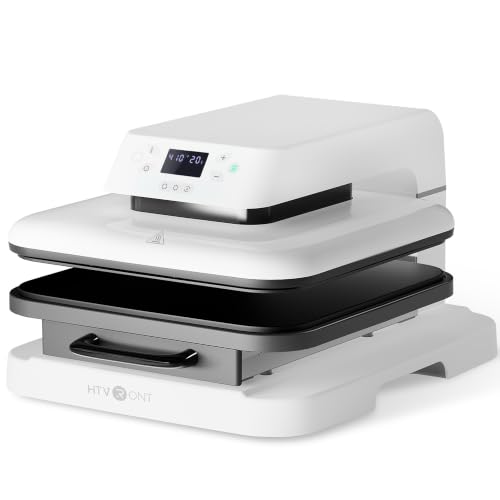
HTVRONT Auto Heat Press Machine for T Shirts - 15x15 Smart T Shirt Press Machine with Auto Release — Best for flat sublimation and HTV apparel work
This is the machine that covers both processes, because a 15x15 platen handles a printed sublimation sheet and a cut vinyl design equally. The manufacturer states the press auto-adjusts to your project's thickness up to 1 inch and auto-releases once the timer counts down [S3].
That auto-release matters more for sublimation than for HTV. Sublimation transfers are unforgiving about dwell time — leaving a shirt under heat past the mark can scorch polyester. A press that lifts itself removes that failure mode.
On heat-up, HTVRONT states that the HTVRONT Auto Heat Press Machine for T Shirts - 15x15 Smart T Shirt Press Machine with Auto Release (B0B6GTVZFH) reaches a common-use temperature of 320°F/160°C within 4 minutes [S3]. The same listing describes a combination of NTC thermistor technology and a dual-tube heating engine for even heat distribution on that model [S3]. Even distribution is the inference that matters here: patchy platens show up as faded corners on sublimation prints and lifting edges on HTV.
Mode options are listed as 4 fast modes, 2 custom modes and an auto mode [S3]. Custom modes are the ones you'll live in, since sublimation and HTV want different time/temp pairs.
Supported strengths: auto press-down and auto-release; separated ironing board and heating plate with a drawer-slide design; automatic shutoff after 15 minutes of non-use; FCC certification claimed by the seller; compatibility stated for wood signs and ceramic coasters up to 1 inch thick [S3].
Purchase-relevant limits: the 1-inch thickness ceiling is the hard boundary for thick substrates [S3]. The supplied listing information does not state a wattage, duty-cycle rating or warranty length. And note that an auto-off timer is a safety feature, not permission to walk away — the seller's FCC statement is a self-declared listing claim, not independent third-party verification.
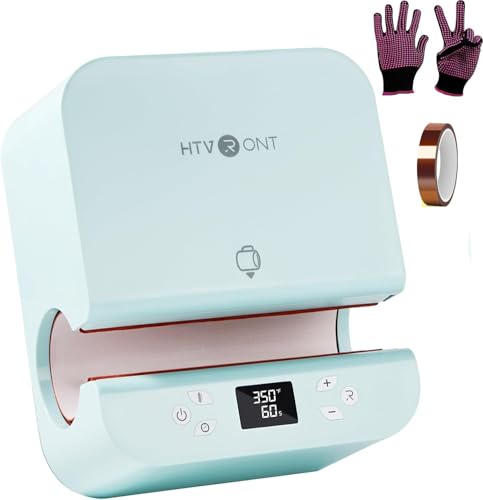
HTVRONT Auto Tumbler Heat Press Machine - Sublimation Tumblers, Glasses — Best for sublimating tumblers within a 2.9 to 3.2 inch diameter
A flat press cannot wrap a tumbler. That's the entire reason this category exists.
HTVRONT lists this press as accommodating tumblers 2.9 inches (7.5cm) to 3.2 inches (8.1cm) in diameter, ranging from 280ml to 850ml [S4]. Read that range carefully before buying blanks — diameter, not volume, is what determines fit, and plenty of popular tumbler shapes fall outside it.
The listing states it applies pressure automatically based on the tumbler's diameter [S4]. Practically, that's aimed at the most common sublimation tumbler failure: uneven pressure producing a ghosted seam line.
Maximum temperature is stated at 390°F/200°C, with the soleplate described as high-temperature resistant material that does not deform or melt [S4]. HTVRONT also claims about 3 minutes saved on heat and transfer time compared with standard tumbler presses [S4] — that's a manufacturer comparison against an unnamed baseline, so treat it as a claim rather than a verified figure.
Supported strengths: automatic pressure by diameter; auto power-down after 15 minutes of inactivity; an emergency stop via the "R" button that halts heating and releases the heat pad; stated compatibility with mugs, tumblers, glassware, cups, water bottles and sippy cups within the fit range [S4].
Purchase-relevant limits: the diameter window is narrow, and the supplied listing information does not state a wattage or warranty term.
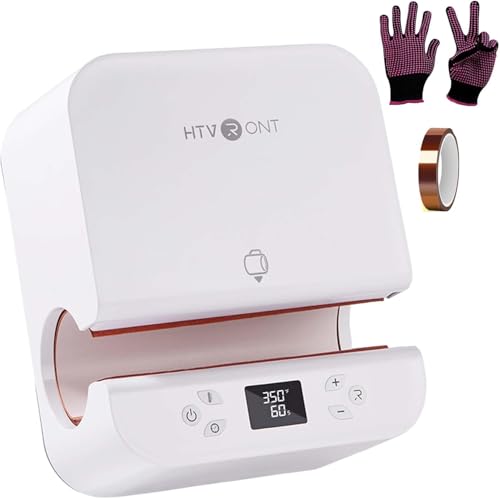
HTVRONT Auto Tumbler Heat Press Machine - Sublimation Tumblers, Glasses — Best for shoppers who size tumblers in ounces
This listing carries the same core specifications as the one above: 2.9 to 3.2 inch diameter fit, a 390°F/200°C maximum temperature, automatic pressure by diameter, auto-off after 15 minutes of inactivity, and the "R" button emergency stop [S5].
The one useful difference on the page is unit labeling: this record states the capacity range as 280ml-850ml (10-30oz) [S5], while the other lists it as 280ml-850ml [S4]. If your blanks are catalogued in ounces, that translation saves a conversion step.
Honestly, that's the only distinction the supplied listings establish. The records do not state which variant differs in color, bundle or region, so pick on whichever listing's current offer suits you.
Purchase-relevant limits: same narrow diameter range, and no wattage or warranty length stated in the supplied listing information.
Sublimation vs HTV: Side by Side
| Factor | Sublimation | HTV |
|---|---|---|
| Works on cotton | No — needs polyester or a polymer coating | Yes |
| Works on dark garments | No — no white ink, dye is translucent | Yes |
| Hand-feel | None; dye is in the fiber | Raised film layer |
| Full-color photo art | Native strength | Difficult; layered colors only |
| Weeding required | No | Yes |
| Core equipment | Sublimation printer, sublimation paper, heat press | Cutting machine, vinyl, weeding tool, heat press |
Sublimation Supplies for Beginners
Start small. A sublimation printer, sublimation paper, butcher paper to catch gassing ink, heat-resistant tape, and light-colored polyester blanks. Add the press that matches your shape — flat or tumbler.
For HTV, the starter list is shorter: cutting machine, a roll of vinyl, a weeding hook, and a Teflon or parchment cover sheet.
Tips for Best Results
- Always mirror your design for both processes.
- Pre-press the garment to drive out moisture — trapped humidity causes blotchy sublimation.
- Use butcher paper under and over sublimation transfers so gassed ink doesn't stain the platen.
- Match time and temperature to the blank's guidance, not to a generic number from a video.
- Check tumbler diameter against your press before ordering a case of blanks.
Common Mistakes to Avoid
- Sublimating a 100% cotton shirt. The color washes out because there's no polyester to bond with.
- Assuming a mug press fits every tumbler. These HTVRONT tumbler presses list a 2.9 to 3.2 inch diameter range [S4].
- Pressing thick substrates on a flat press. The apparel press is stated to accommodate up to 1 inch of thickness [S3].
- Leaving a press unattended. An auto-off feature after 15 minutes of inactivity [S3] is a fallback, not supervision. The CPSC publishes general consumer product safety guidance worth reading before running hot equipment at home [S1].
- Skipping the cover sheet. Scorched platens and shiny press marks are permanent.
How We Research
This website does not perform hands-on testing. For this page, product facts came from Amazon Creators API verified product records and the product listing feature bullets published on each ASIN's Amazon page, retrieved 2026-09-09. Where the manufacturer publishes a figure — heat-up time, temperature ceiling, diameter range — it is attributed to them rather than presented as an observation.
Final Verdict
If you press flat goods and want one machine that serves both sublimation and HTV, the HTVRONT Auto Heat Press Machine for T Shirts is the sensible base, because the auto-release-on-timer behavior published for it [S3] directly addresses sublimation's dwell-time sensitivity.
If tumblers are your product line, add a curved press — but measure first. Both HTVRONT tumbler models publish the same 2.9 to 3.2 inch diameter window [S4], and no amount of clever technique fixes a blank that doesn't fit the pad.
And on the core question: stop thinking of sublimation vs HTV as a rivalry. Polyester and light colors go to sublimation. Cotton and dark garments go to HTV. The blank decides.
Related Resources
- Heat press temperature guide
- Best cutting machines for beginners
- How to weed HTV without tearing it
- USA.gov consumer protection resources for buyers [S2]
Sources & Methodology
Nothing on this page was pressed, timed, or measured by anyone here — this site runs no lab and does no physical product testing. What informs the recommendations above is close reading of Amazon Creators API verified product records and the manufacturer-written listing feature bullets for ASINs B0B6GTVZFH, B0CG166C88 and B0CG54TBGY, all retrieved 2026-09-09, cross-checked against each other for scope and for what the listings notably leave unstated. For heat presses that's more useful than it sounds: fit dimensions, thickness ceilings and temperature limits are the specs that decide whether a project succeeds, and those are published numbers you can verify on the listing yourself before you buy a single blank.
People Also Ask
What is sublimation printing?
See the full breakdown in the article above — we cover this in detail with real-world numbers and product recommendations.
Can you sublimate on cotton?
See the full breakdown in the article above — we cover this in detail with real-world numbers and product recommendations.
Do i need a cutting machine for sublimation?
See the full breakdown in the article above — we cover this in detail with real-world numbers and product recommendations.