As an Amazon Associate this site earns from qualifying purchases.
Quick Picks
| Product | Platen | Heating design | Arm type | Listed applications | Link |
|---|---|---|---|---|---|
| VEVOR Heat Press Machine 12 x 15 Inch 8 in 1 Heat Press Sublimation Machine 360° Rotation Swing Away 8 in 1 Shirt Printing Machine Dual-Tube Heating for DIY T-Shirts Cap & Mugs Blue | 12" x 15" (29 x 38 cm), Teflon-coated | Dual-tube | 360° swing-away | Caps, T-shirts, mugs, plates, aluminum pots | Check Price on Amazon |
Disclosure: We earn a small commission from qualifying Amazon purchases at no extra cost to you.
Last Updated: September 2026
Look, if you typed "vevor 8 in 1 heat press 15x15" into a search bar, the first thing you need is a size correction, not a sales pitch. The VEVOR 8-in-1 machine analyzed on this page is listed with a 12" x 15" (29 x 38 cm) heat platen, according to the Amazon product listing. That is a 12 by 15 press, not a 15 by 15 press. Everything below is built on that listing's published specifications — this website does not do hands-on testing, so nothing here is a personal impression, a timing, or a measurement taken by anyone at this site.
What follows is a close reading of what VEVOR actually publishes about this machine, what those numbers plausibly mean for a T-shirt-and-mug side hustle, and — just as important — the specifications the supplied listing information does not state.
Review at a Glance
- Best For: Crafters who want one machine that covers flat garments plus curved blanks like caps and mugs, and who prefer a swing-away arm over a clamshell.
- Platen size: 12" x 15" (29 x 38 cm), Teflon-coated, per the listing.
- Pros (all listing-stated): Dual-tube heating with a claimed center-to-edge temperature difference of about 5°C; 360° swing-away arm; dual-screen digital controller with °C/°F switching; two layers of insulation with a claimed 50-70°C surface temperature at a 210°C working temperature; 8-in-1 attachment kit covering caps, T-shirts, mugs, plates and aluminum pots.
- Limitations: It is a 12 x 15 platen, not 15 x 15. The supplied listing information does not state wattage, voltage, maximum temperature, timer range, machine weight, pressure adjustment method, attachment dimensions, or warranty length. No aggregate customer rating was supplied for this ASIN.
First, the 15x15 Question
Here's the thing: "15x15" is the default mental image for a hobby heat press, so a lot of shoppers search for it by habit. The VEVOR unit reviewed here is published with a 12" x 15" platen. That difference is three inches on one side of the platen, and the supplied listing information does not state which of the 12" x 15" (29 x 38 cm) dimensions runs across the garment.
What a 12 x 15 platen does give you is a press area that accommodates a standard letter-size transfer sheet, with room to spare. For pocket prints, sleeve hits, youth sizes, tote bags and most standard chest graphics, the press area is rarely the constraint. For oversized back prints or all-over-ish designs, it can be.
If a true 15 x 15 platen is non-negotiable for your work, this is not that machine, and no amount of feature-count marketing changes the geometry. Confirm the platen dimension on the listing page before you order, since VEVOR sells multiple heat press sizes.
Overview: What the Listing and Specifications Show
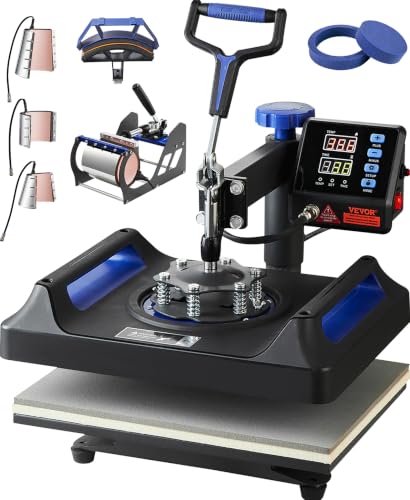
The VEVOR 8-in-1 is a multifunction heat press: one base unit with swappable platens intended to cover flat and curved substrates. VEVOR's listing describes it as suitable for applying letters, numbers and patterns onto caps, T-shirts, mugs, plates and aluminum pots.
Note the scope of that sentence. It names five substrate types in a product marketed as 8-in-1. The supplied listing information does not itemize all eight attachments, nor does it state mug diameters, cap platen dimensions, or plate sizes. If you have a specific blank in mind — a 20 oz skinny tumbler, say, or a 6-inch plate — the supplied record cannot confirm that attachment fits it. Ask VEVOR or the seller for the attachment dimension list before committing.
The headline engineering claims are three: dual-tube heating, a 360° swing-away arm, and double-layer insulation. Each one is a real, checkable design decision rather than a vague adjective, which is more than a lot of budget presses offer in their bullets.
Key Features and Specifications
The table below compares each published figure against the baseline VEVOR itself cites in the same bullet. That is the only comparison baseline available here — it is the manufacturer's characterization of older or "traditional" designs, not an independent category average.
| Specification | VEVOR's published figure | Baseline cited in the same listing bullet |
|---|---|---|
| Heating element | Dual-tube (double-tube) | "Ordinary single tube heating" |
| Center-to-edge temperature difference | About 5°C | More than 10°C for "old-fashioned" heating tubes |
| Exterior surface temperature at 210°C working temperature | About 50-70°C | 70-100°C for "traditional" shirt press machines |
| Platen | 12" x 15" (29 x 38 cm), Teflon-coated, non-stick | Not stated |
| Arm movement | 360° swing-away | Not stated |
| Controller | Digital, dual-screen display, silicone buttons, °C/°F toggle via (+/-) | Not stated |
| Listed applications | Caps, T-shirts, mugs, plates, aluminum pots | Not stated |
Fields the supplied listing information does not state: wattage, voltage, maximum settable temperature, timer range, pressure adjustment mechanism, machine weight and shipping dimensions, duty cycle, and warranty term. Those are genuine gaps in the record supplied here, not evidence that VEVOR never publishes them anywhere.
Expected Performance, Based on Manufacturer and Listing Data
Start with the number that actually predicts print quality: heat uniformity. VEVOR states a center-to-edge temperature difference of about 5°C on this dual-tube design, versus more than 10°C on what it calls old-fashioned heating tubes. If that holds in normal use, the practical inference is fewer under-cured corners on large HTV designs and less color shift at the edges of a full-platen sublimation transfer.
Why it matters: sublimation and heat transfer vinyl both have a working window, and the edges of a platen are where a press usually falls short of it. A tighter spread means the same dwell time should be closer to correct across the whole print area. That is an inference from the published figure, not a result observed here.
The dual-screen digital controller is the second performance-relevant detail. For ASIN B099NCM9NC, the listing states dual-screen displays and silicone buttons, and VEVOR notes you can switch between °C and °F with the (+/-) buttons; the supplied listing information does not state what the second display shows. For anyone working from mixed transfer instructions — some blanks list Fahrenheit, some list Celsius — that toggle removes a conversion step and a category of dumb mistakes.
What the record cannot establish is cycle-to-cycle consistency, recovery speed after opening, or how long a session it tolerates. The supplied listing information does not state a duty-cycle rating or a heat-up time, so I will not guess at either. If you are planning production volume rather than weekend batches, treat that as an open question to raise with the seller.
Build Quality and Design
The swing-away arm is the design choice I would weigh most heavily. VEVOR states the arm swings 360° and that this applies pressure directly and evenly onto the substrate, while allowing the heating element to move to the side and reduce the chance of accidental contact.
Translate that into shop-floor terms. A clamshell hinges over your work like a laptop lid, which means your hands are underneath a hot platen while you position a shirt. A swing-away moves the heat block off to the side entirely, so layout happens over an unobstructed lower platen. For layered HTV, where you reposition a design two or three times, that is a workflow difference, not a spec-sheet nicety.
The cost of a swing-away is bench space. The arm needs clearance to rotate, so a press like this wants a deeper, more open table than a clamshell of the same platen size. The listing does not state the machine's footprint or the swing radius, so measure your table and confirm dimensions with the seller before you clear a shelf for it.
Read that carefully. 50-70°C is cooler, but it is still hot enough to hurt — this is a lower-burn-risk claim by the seller, not a certification and not permission to treat any exterior as touch-safe. A seller's claim is not independent verification. For general consumer safety context and recall notices, the U.S. Consumer Product Safety Commission publishes product safety information at cpsc.gov.
The platen surface is Teflon-coated and described as non-stick and stable. Practically, VEVOR describes that coating as non-stick and stable, which is aimed at keeping stray adhesive from bonding to the plate; follow your transfer material's instructions and VEVOR's own guidance on when a protective cover sheet is required. It is also a wear surface: coated platens are consumables over long horizons, and the supplied listing information does not state a replacement platen availability or a coating warranty.
Value for Money
Check current price on Amazon, because a static page is the wrong place to quote a number that moves.
What you can assess without a price is what you get for whatever it costs: a 12 x 15 Teflon-coated platen, a dual-tube element with a stated 5°C center-to-edge spread, a 360° swing-away arm, a dual-screen digital controller with °C/°F switching, and an attachment kit VEVOR lists as covering caps, T-shirts, mugs, plates and aluminum pots.
The honest framing is bundle economics. Buying a dedicated flat press, a separate mug press and a separate cap press means three machines, three footprints and three power cords. An 8-in-1 consolidates that. The tradeoff with any multifunction unit is that swapping platens takes time and the individual attachments are usually less specialized than a purpose-built machine. VEVOR's listing does not describe the attachment-swap mechanism, so how quick that changeover is remains unestablished by the supplied record.
Who Should Buy This
- Etsy-style sellers with a mixed catalog. If your product mix is shirts plus mugs plus caps, a single 8-in-1 base with the listed attachment coverage is the argument for this machine.
- Crafters upgrading from a portable mini press. The 12" x 15" platen is a meaningful jump in press area over a handheld unit, and ASIN B099NCM9NC's listing states a digital dual-screen controller with (+/-) °C/°F switching.
- Anyone who does layered vinyl. The 360° swing-away arm moves the heating element aside for layout, which is the ergonomic case for swing-away over clamshell.
- Buyers who want tighter edge-to-edge heat on a budget platen. The stated ~5°C center-to-edge difference is the specific reason to prefer this over a single-tube design, per VEVOR's own comparison.
If you are still deciding between machine types, our heat press vs. EasyPress comparison and heat press temperature and time guide cover the decision from the workflow side.
How We Research
This website does not perform hands-on or laboratory testing, and it says so on every page. For this review, the evidence base was an Amazon Creators API verified product record for ASIN B099NCM9NC and the product's own listing feature bullets, both retrieved 2026-09-09.
The method is close reading rather than benchmarking: pull every published figure, check what baseline the manufacturer is comparing against, separate engineering specifications from marketing adjectives, and flag every field the record leaves blank instead of filling it from memory. Where VEVOR compares itself to "ordinary" or "traditional" machines, that comparison is attributed to VEVOR — it is not an independent category measurement.
Final Verdict
Buy it if your work is genuinely multi-substrate and a 12 x 15 press area fits your largest design. The two specifications that justify it over a generic budget press are concrete: VEVOR's stated ~5°C center-to-edge temperature difference from the dual-tube element, and the 360° swing-away arm that clears the heating block off your layout area. Those are design decisions with real consequences for print consistency and for how comfortably you work.
Don't buy it if you came here for a 15x15. The listing is explicit that the platen is 12" x 15" (29 x 38 cm), and pretending otherwise costs you three inches on one of the two dimensions.
And go in with your eyes open about the gaps. Wattage, timer range, maximum temperature, weight, footprint, attachment dimensions and warranty are not in the supplied listing information. For a machine that will run at a stated 210°C working temperature next to your hands, those are fair questions to put to the seller before you check out — and general guidance on consumer rights and complaint channels is available through USA.gov's consumer protection resources.
Frequently Asked Questions
What can the VEVOR 8-in-1 heat press print on? VEVOR's listing says it is suitable for applying letters, numbers and patterns onto caps, T-shirts, mugs, plates and aluminum pots. The supplied listing information does not itemize all eight attachments or state their individual dimensions, so check attachment sizes with the seller if you have a specific blank in mind.
What is dual-tube heating and does it matter? It means two heating tubes in the platen instead of one. VEVOR states the design produces a center-to-edge temperature difference of about 5°C, compared with more than 10°C for what it calls old-fashioned heating tubes. More even heat across the platen plausibly means more consistent curing at the edges of large transfers, though that is an inference from the published figure.
Is a swing-away press better than a clamshell? Different, and better for some jobs. VEVOR states the 360° swing-away arm applies pressure directly and evenly and moves the heating element to the side, reducing the chance of accidental contact. That helps when you are positioning layered vinyl, but it needs more bench clearance than a clamshell.
Does the machine display Fahrenheit or Celsius? Both. The listing states the digital controller has dual-screen displays and that pressing (+/-) switches between °C and °F.
How hot does the outside of the machine get? That is the seller's claim, not independent verification, and 50-70°C is still hot enough to cause burns — treat all exterior surfaces as hot during and after use.
Does the listing state the wattage or warranty? Not in the information supplied here. Wattage, voltage, maximum temperature, timer range, weight and warranty length are not stated in the supplied listing record, which does not mean VEVOR never publishes them — request them from VEVOR or the seller if they affect your decision.
Sources and Methodology
No one at this website pressed a shirt, timed a heat-up cycle, or put a thermocouple on this platen — there is no lab here and no unit was handled. What this review is built from is the Amazon Creators API verified product record for ASIN B099NCM9NC and that listing's own feature bullets, both retrieved on 2026-09-09, read line by line to separate published engineering figures from marketing framing and to identify which fields the record simply does not contain.
For heat presses, that kind of specification reading gets you further than it does in most categories, because the numbers that predict print quality — platen dimensions, heat-element layout, center-to-edge temperature spread, arm geometry — are exactly the ones manufacturers publish. What it cannot tell you is longevity, unit-to-unit consistency, or how the machine behaves in its fifth hour of a production run, and this page does not pretend otherwise.